This note compares how threat vectors shift when an AI inference system moves from a connected cloud environment to offline deployment.
Offline here means physically and logically air-gapped: no inbound or outbound connectivity to external networks or the public internet. Data moves only through controlled physical media with human-in-the-loop procedures. Unidirectional gateways and intermittent sync sit outside this scope.
Threat bounds: data exfiltration, unauthorized execution, supply-chain corruption. Attacker model: a motivated actor with remote reach before air-gap, or physical proximity / insider access after. Regulatory claims rest on NIST and CMMC source text. Operational complexity claims are architectural opinion from practitioner deployments, not a new empirical study.
Breach cost as backdrop
IBM’s 2025 Cost of a Data Breach Report1 puts average global breach cost at $4.44 million. Breaches spanning multiple environments average $5.05 million and take longer to contain. On-premises breaches average $4.01 million with shorter detection.
Those figures describe complexity and cost correlation. They do not prove that air-gapping lowers breach cost by the difference between those averages. Use them as backdrop for where systems run and how data moves — not as a savings claim.
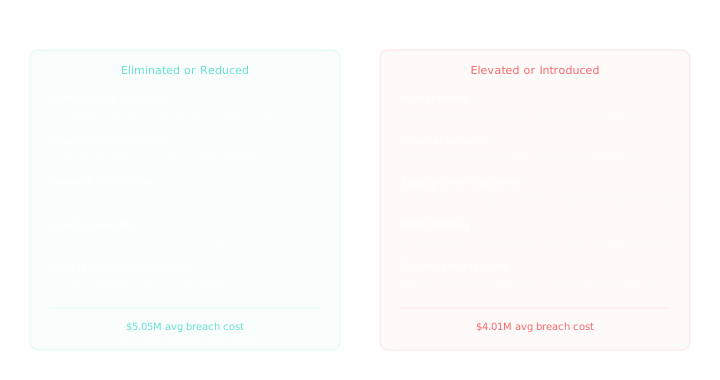
Vectors that shrink offline
In a simplified comparison, an air-gapped or tightly network-restricted AI deployment eliminates or severely constrains several conventional paths:
Remote exploitation. No network listener means no remote code execution via an exposed inference endpoint. The class of attacks that begin with “attacker sends a crafted request” disappears if there is no endpoint.
Cloud misconfiguration. Misconfigured object storage, over-permissive IAM, leaked API keys to model providers — none apply when the system does not talk to those services.
Network exfiltration. Without a network path, data cannot leave through it. Exfiltration surface narrows to physical channels and authorized transfer procedures.
Vendor telemetry and continuous supply chain. License checks, usage telemetry, model-update pings: each outbound connection is both a data-movement risk and an availability dependency. Removing them simplifies the security boundary.
Vectors that rise offline
Offline operation shifts risk. It does not automatically reduce it.
Insider threat rises in relative weight. With external vectors gone, remaining paths are internal: physical access, authorized misuse, social engineering against operators. NIST SP 800-1712 still requires access control and audit regardless of connectivity.
Physical security becomes load-bearing. The boundary is the facility perimeter and media-handling procedure. NIST guidance on air-gapped environments3 treats systems where data transfer is only possible through human interaction; media protection (sanitization, tracking, access logging) carries more weight when removable media is the only data path.
Supply-chain integrity moves to delivery time. Connected systems face ongoing update risk. Offline systems face risk at install and at physical media updates. The window is narrower and higher-consequence: compromised media may persist longer before detection.
Patching becomes a planned operation. Security fixes require staging, validation, physical transfer, and a maintenance window. Unpatched issues persist until the next cycle. That accepted risk window is a documented policy choice, not an accident.
CMMC and air-gapped CUI
For contractors handling Controlled Unclassified Information, CMMC under 32 CFR Part 1704 applies NIST SP 800-171. Air-gapping can limit scope. It does not cut the control count.
Scoping guidance5 allows isolating CUI into separate domains with physical or logical separation. All 110 requirements still apply inside that domain. Some network-specific controls may be satisfied differently — remote access is less relevant when there is no remote access — but access management, audit logging, media protection, and configuration management remain fully in force.
Practical implication: offline AI in a CMMC-scoped environment needs the same governance rigor as a connected one, applied to different boundaries.
Dependency control
The most common failure mode we see in offline AI is not a sophisticated attack. It is an unmanaged dependency: a framework that assumes network at init, a library that phones home for license checks, a driver that probes for updates. Those are availability failures first — and they can also violate an air-gap claim if the connection succeeds.
Dependency control is a first-order architectural concern6. Every unmanaged dependency is either a failure waiting for the wrong moment or an unintended network path waiting to be found.
Threat model contents
For organizations building an offline AI threat model:
- Map every data-movement path, including physical media, maintenance connections, and diagnostic interfaces.
- Identify which NIST 800-171 controls change in implementation (not applicability) because of air-gapping.
- Define patching cadence and the accepted risk window between disclosure and offline fix.
- Inventory every external dependency in the inference stack and prove each one works without network access.
- Treat hardware variation across deployments7 as configuration management, not only performance.
- If the infrastructure serves multiple workloads or classification levels, treat multi-tenant isolation8 as part of the same model.
Facilities that operate well here share one trait: they document the differences honestly. Air-gapping has real security benefits. It is not a shortcut around discipline.
References
IBM Security, "Cost of a Data Breach Report 2025," ibm.com/reports/data-breach.
NIST Special Publication 800-171 Rev. 3, "Protecting Controlled Unclassified Information in Nonfederal Systems and Organizations," csrc.nist.gov.
NIST Special Publication 800-171 Rev. 2, Section 3.8 Media Protection, nvlpubs.nist.gov.
32 CFR Part 170, "Cybersecurity Maturity Model Certification (CMMC) Program," ecfr.gov.
NIST SP 800-171 scoping guidance (Appendix E materials), as used in assessment programs.